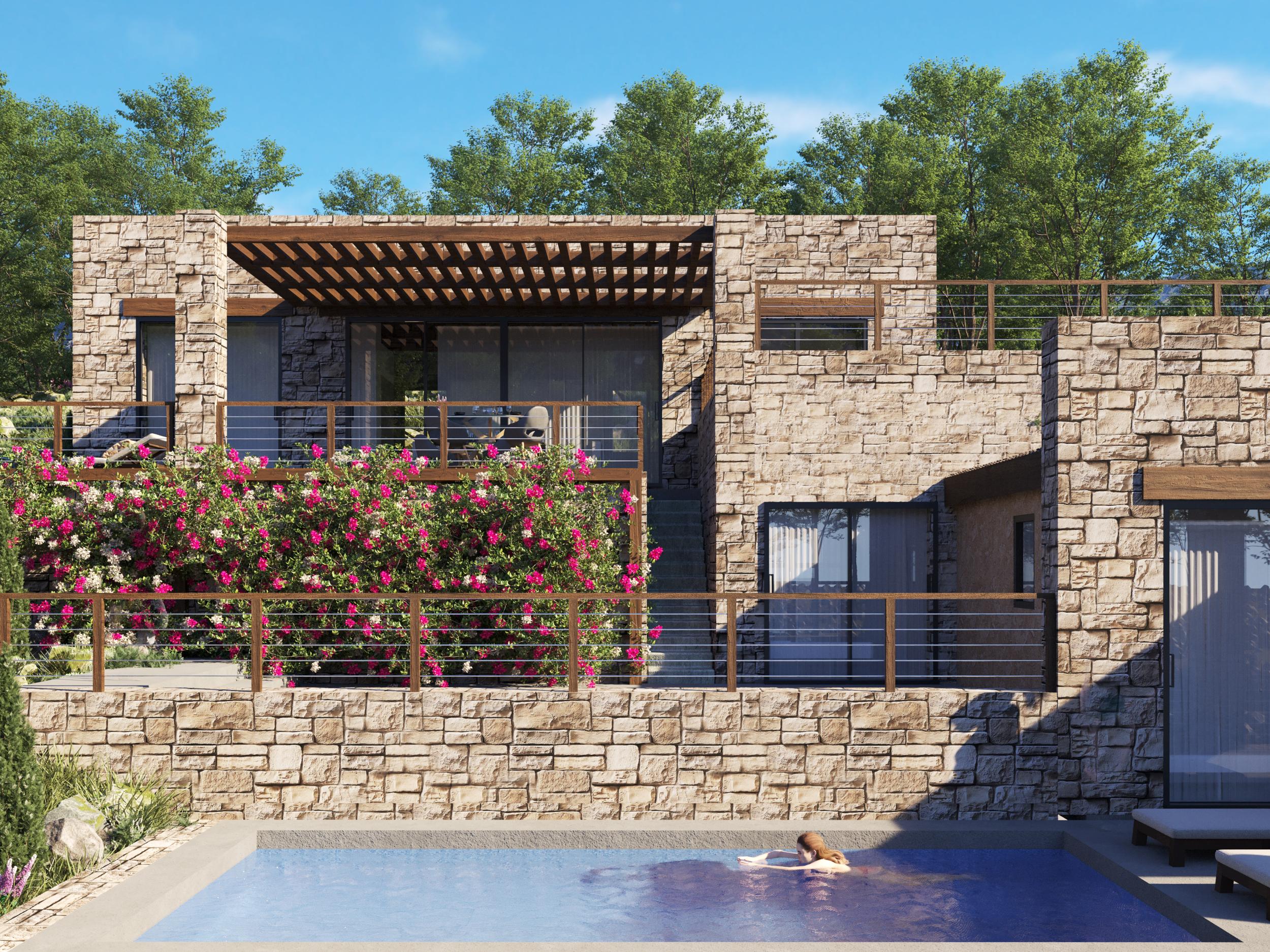
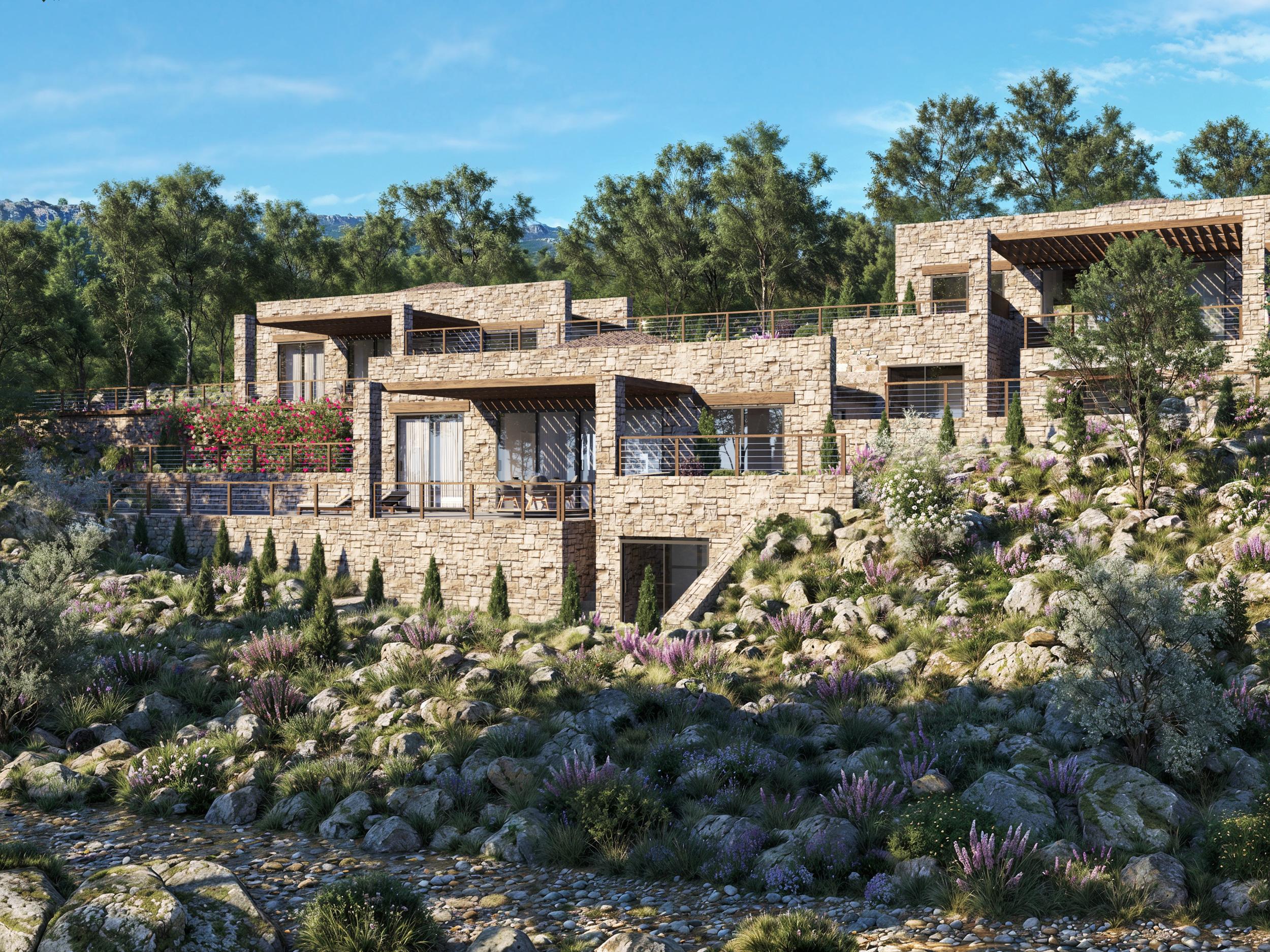
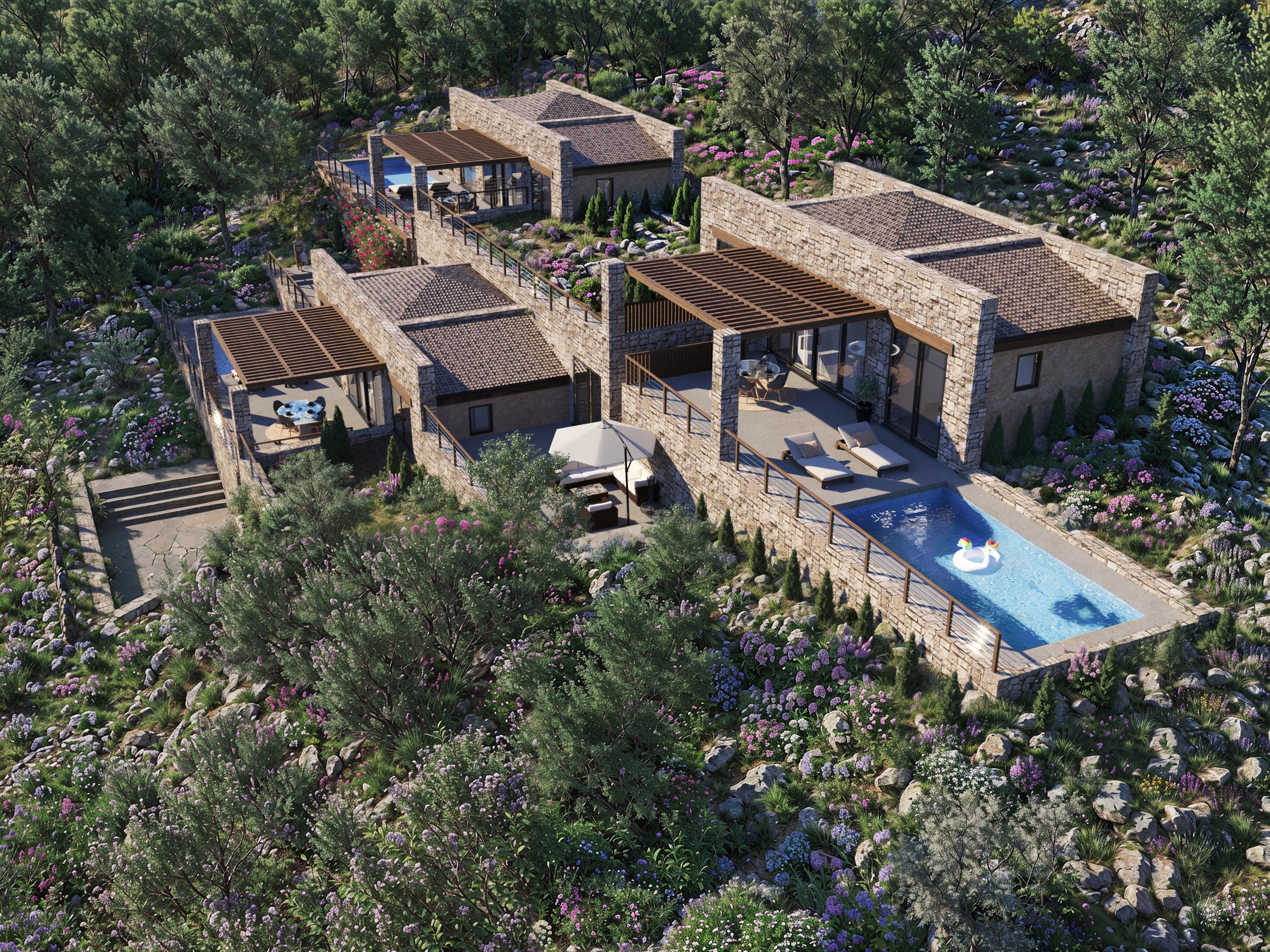
Located on the sloping terrain above Karavomylos in Kefalonia, this project comprises three private villas designed as an integrated architectural ensemble. The proposal explores a contemporary interpretation of local residential typologies, responding to topography, climate, and material tradition through a restrained and site-specific architectural language.
Rather than approaching the site as a single object, the design is articulated as a series of low, stone-clad volumes that follow the natural contours of the hillside. The buildings step gradually with the terrain, minimizing excavation while ensuring unobstructed views toward the Ionian Sea for each residence.
Each villa is organized across terraced levels, establishing a clear gradient from private to communal spaces. Living areas open directly onto shaded verandas and outdoor terraces, extending interior space toward the landscape and reinforcing a continuous indoor–outdoor relationship. Circulation is conceived as a sequence of transitions between enclosed and open spaces, with exterior stairs connecting gardens, pools, and lower terraces.
The arrangement of volumes ensures visual privacy between neighboring dwellings while maintaining openness toward the sea and the surrounding landscape.
Materiality plays a central role in anchoring the architecture within its context. Locally sourced stone forms the primary exterior envelope, laid in irregular courses that echo the island’s traditional construction methods while providing thermal mass and durability. Timber pergolas introduce rhythm, shade, and scale, while metal railings and recessed glazing contribute a contemporary precision to the composition.
The limited palette—stone, wood, metal, and glass—allows light, shadow, and texture to define the architectural experience rather than overt formal gestures.
The landscape strategy is based on minimal intervention. Existing vegetation is preserved where possible and complemented by native, drought-resistant species. Retaining walls, paths, and terraces are constructed from the same local stone as the buildings, extending the architectural language into the site and reinforcing a cohesive relationship between built form and terrain.
The project does not replicate traditional forms, but reinterprets them through proportion, material authenticity, and spatial logic. The villas engage with local architectural heritage in an abstract and contemporary manner, prioritizing permanence, climatic responsiveness, and contextual continuity.
The result is a collection of residences that are deeply embedded in their environment—architecture shaped by landscape, material, and the slow rhythms of island life.